
Plumbing rough-in is the part of a bathroom or kitchen renovation done before tiling: the water and drain pipes are run to where the toilet, sink, shower and washing machine will stand, and the ends are left at the right height. We build new outlets, move existing ones, set pipes into the wall and pressure test the system while it is still visible. One outlet costs from €40, wall chasing is charged separately, and we agree the price before the work starts.
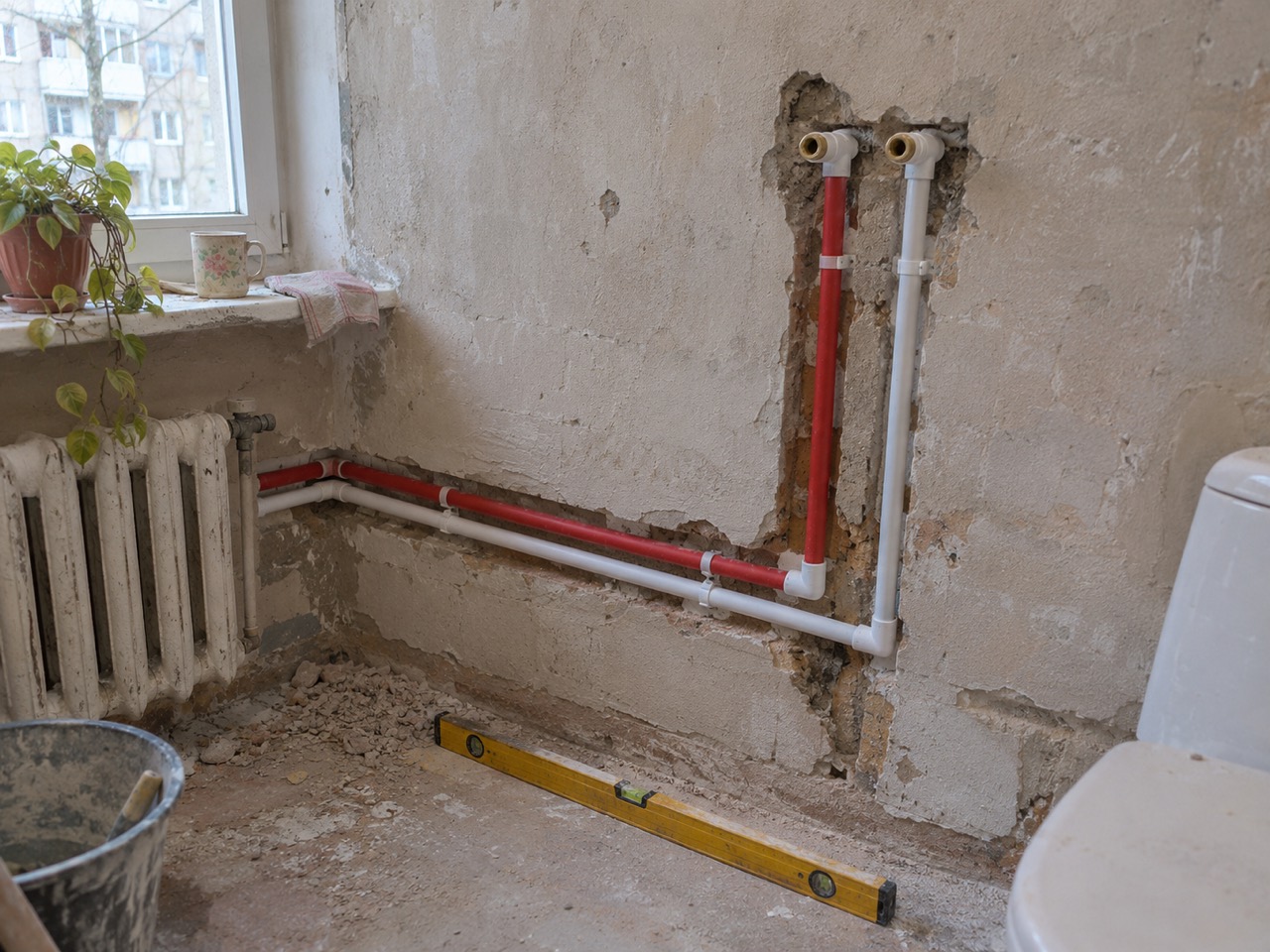
After tiling, an outlet cannot be moved even a centimetre without breaking tiles. So at this stage you need to know not only where the fixtures go but the actual models: the concealed toilet frame, the vanity unit, the shower system or the concealed mixer tap. For each of them the manufacturer's installation instructions state where the water and drain ends must be.
The second thing is the drainage. A water pipe can run in any direction, because pressure drives the water, but a drain pipe needs a fall towards the riser along its whole length. The further the new fixture is from the riser, the higher the pipe has to start, and that decides whether it can be hidden in the wall, in the floor or only in boxing.
The table gives indicative heights from the finished floor to start planning with. The final height is set by the installation instructions of the chosen fixture, so it is better to choose the fixtures before the rough-in.
| Fixture | Water outlet | Drain outlet |
|---|---|---|
| Floor-standing toilet | side or rear, about 15–25 cm, at the cistern valve | 110 mm, horizontal or vertical to suit the toilet outlet |
| Wall-hung toilet | inside the frame, per the frame instructions | 110 mm, at the frame connection |
| Sink | about 50–60 cm, behind the vanity unit or pedestal | 40–50 mm, about 45–55 cm |
| Shower with a wall-mounted mixer | mixer about 100–120 cm, shower head to suit the users' height | floor drain or tray waste in the floor, with a fall |
| Washing machine | a separate valve behind the machine, reachable without pulling the machine out | 50 mm with a trap; the drain height is set by the machine manufacturer |
For concealed installation the pipes are laid in a groove cut into the wall, a chase, or behind a plasterboard false wall. Wall chasing in brick, aerated concrete and concrete differs in time, dust and tools, so it is charged separately per metre.
Long horizontal chases weaken a load-bearing wall. There it is often better to run the pipes along the floor or build a false wall, which can also hide the concealed toilet frame.
Only joints designed for concealed installation are left in the wall, for example press fittings or welded PPR joints. Threaded joints and valves are left accessible behind an access hatch.
In a tee (T) system one pipe runs past the fixtures, and each has its own branch. In a manifold system each fixture has its own pipe from the distribution manifold with a separate valve. A manifold needs more pipe and space for a cabinet, but it lets you shut off one fixture without stopping the water in the whole apartment, and the pipes in the wall have no joints.
In an apartment the manifold is usually placed after the inlet valves and the meter assembly, in a private house after the inlet. For the internal plumbing of a whole house see plumbing installation in a private house.
Moving a toilet is the most complicated outlet job, because the 110 mm drain pipe needs a fall to the riser and a connection to the riser tee. A toilet can usually be moved a couple of dozen centimetres with a short extension. If the new spot is further away, the pipe has to run in the floor or a false wall, and sometimes the floor has to be raised.
If the fall cannot be achieved, for example in a cellar or far from the riser, the solution is a sewage pumping unit: see the sump and sewage pump page. If the toilet becomes wall-hung, the frame is installed at this same stage and the toilet bowl after tiling: toilet installation.
If the riser tee itself has to be replaced, that is work on the building's common property and is agreed with the house manager. More on the riser replacement page.
Fixture positions on the walls
The fixture centre lines and outlet heights are marked on the walls to suit the chosen fixtures. If the fixtures have not been chosen yet, now is the time.
Shutting off the water
In an apartment the inlet valves are closed. If they do not close or a connection to the riser is needed, shutting off the riser is arranged with the house manager.
Removing the old installation
The old pipes are removed up to the point where the new system will start.
Chasing and pipes
The chases are cut, and the water and drain pipes, the manifold or branches, the concealed toilet frame and the concealed mixer body are installed.
Pressure test
The water system is filled and held at the test pressure set by the pipe manufacturer while the gauge is watched. The drainage is tested with water. Only then are the pipes closed in.
Photo map of the pipes
Before the walls are closed, all the pipes are photographed with a tape measure alongside, so that later you know where not to drill.
Protecting the outlets
The ends are sealed with caps so that no mortar or dust gets in during tiling. The fixtures are installed after tiling.
| Job | Price | Note |
|---|---|---|
| One outlet (water or drainage point) | from €40 | for 1 point, materials extra |
| Wall chasing | separately | per metre, depends on the wall material |
The price depends on the number of points and the distance to the riser or manifold, and on the pipe system (PEX, multilayer PEX-AL-PEX, PPR or press fittings). The wall material, concealed frames and concealed mixer taps, a shower without a tray and removing the old installation also matter. A bathroom with a toilet, sink, shower and washing machine needs several water and drainage points, so we calculate the total from the list of points.
The price does not include materials (pipes, fittings, valves, manifold), filling the chases unless agreed, installing the fixtures, or shutting off the riser through the house manager. Installing the fixtures after tiling is a separate job: bathroom plumbing. You can see all jobs on the plumbing services page.
| Service | Price | Notes |
|---|---|---|
| Building or moving a plumbing outlet | from €40 | for 1 water or drainage point; materials extra |
| Wall chasing for pipes | separately | per metre; depends on the wall material |
Sources
After submitting the form, we'll contact you within 5 minutes!
We'll contact you shortly.